Five History Incursions for Year 7-8 That Don't Feel Like a Waste of Time
A Year 8 teacher once told me most history incursions feel like expensive storytelling sessions. Here are five Victorian programmes that go deeper - and why they're worth considering for your medieval or ancient history units.
By Johnny Paul
Published on 30 April 2025
A Year 8 teacher in Brunswick told me she'd stopped booking history incursions.
"They'd turn up, talk at the kids for an hour about medieval castles or ancient Rome, and leave," she said. "It was basically an expensive lecture. The students were bored. I was frustrated. And I couldn't justify the cost when we could have just watched a documentary."
I've heard versions of this story enough times to know that a lot of history incursions don't work. They're too passive. Too performative. Too disconnected from what students are actually studying.
But here's the thing: when they're done well, history incursions can do something classrooms can't. They can make the past tangible. They can let students hold a piece of chainmail, write with a quill, or hear from someone whose expertise goes deeper than a textbook.
The difference is in the execution.
So here are five history programmes in Victoria that teachers have told me actually work for Year 7-8. Not because they're flashy. But because they connect to the curriculum, engage students actively, and leave something behind that sticks.
What Year 7-8 history actually covers
Before we get into the programmes, it's worth naming what teachers are dealing with.
Year 7 is ancient history: Egypt, Greece, Rome, China, India. Big civilisations. Long timelines. A lot of ground to cover.
Year 8 is medieval and early modern: feudal Europe, Islamic civilisations, the expansion of trade and the growth of contact between societies, and indigenous histories.
The challenge for teachers is making these distant time periods feel real. Textbooks can tell students about feudalism or the Silk Road. But understanding what life was actually like - how people thought, what they valued, how societies functioned - that's harder to teach from a desk.
That's where good incursions and excursions come in.
1. Kryal Castle - Medieval Europe (excursion, not incursion)
Year 7-10 | Ballarat | Contact for pricing
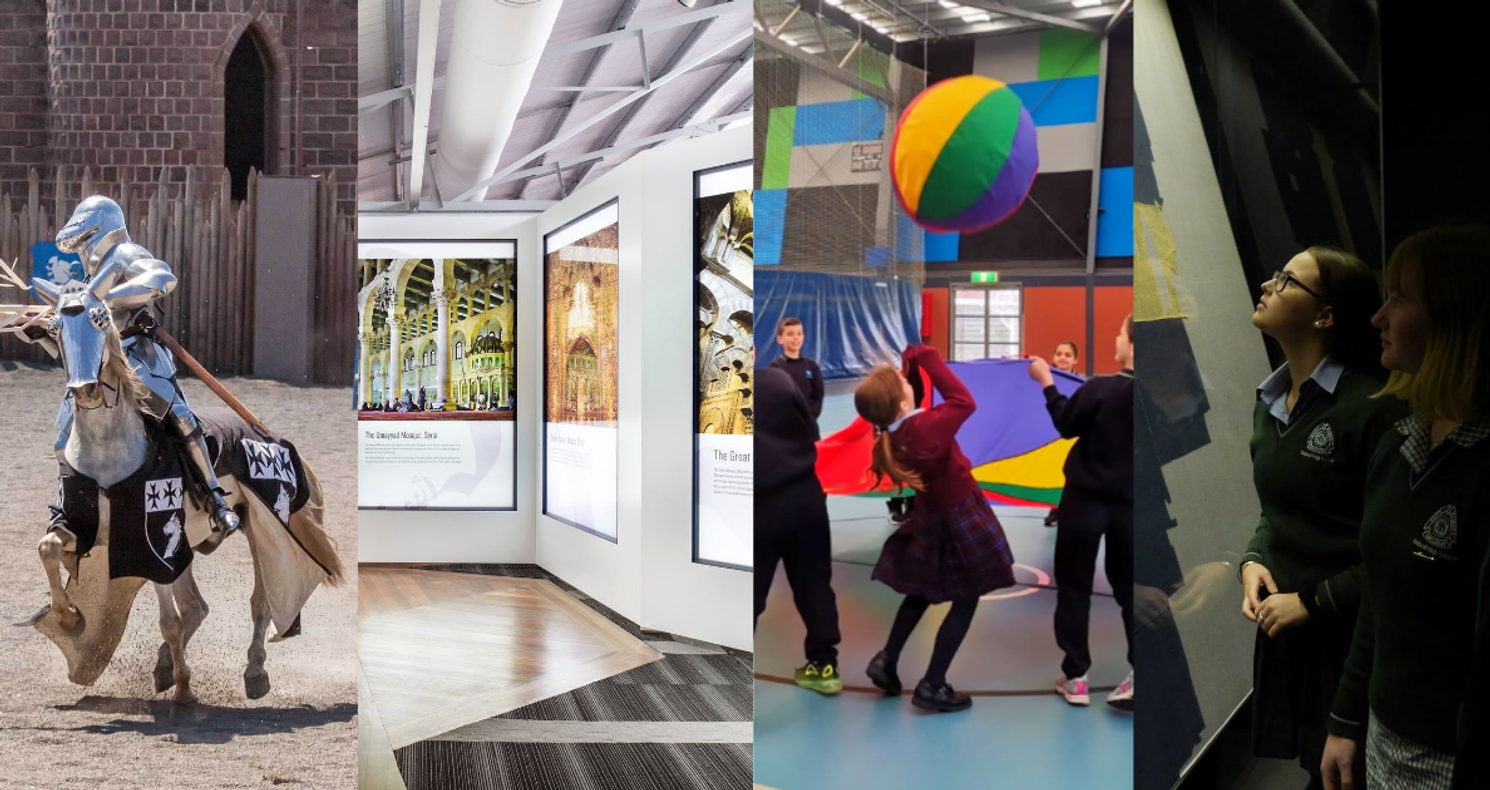
Kryal Castle is a working medieval-themed venue in Ballarat, and they run education programmes specifically designed for secondary students studying medieval Europe.
This is an excursion, not an incursion (you need to travel to them), but it's worth including because it's one of the few places in Victoria where students can actually step into a medieval setting and interact with authentic replicas.
The programmes are modular, so you can focus on specific aspects of medieval life: social hierarchy, warfare, daily life, religion, trade. Students handle real chainmail, try calligraphy with quill and ink, participate in medieval games, and explore the physical structure of a castle.
The presenters know the curriculum and can tie activities directly to what students are studying. It's not just dress-ups and fun (though there is that). It's structured around historical concepts like hierarchy, power, and daily life in the Middle Ages.
Practical notes: It's in Ballarat, so you'll need to factor in travel time from Melbourne (about 90 minutes each way). The programmes run for a few hours, so it's a full-day excursion. If you're doing a medieval Europe unit in Year 8, it's one of the better hands-on options in the state.
Curriculum links: Medieval Europe (Year 8)
2. Medieval Europe and Islam Package - Islamic Museum of Australia
Year 7-12 | Incursion | From $10 per student
This one's clever because it fills a gap most medieval units miss: the Islamic world during the Middle Ages.
While European societies were in the so-called Dark Ages, Islamic civilisations were thriving. They were making advances in mathematics, medicine, astronomy, and philosophy that would later shape the Renaissance. But a lot of Australian students finish Year 8 without really understanding this.
The Islamic Museum runs an incursion that explores Islamic contributions to science, art, and knowledge during the medieval period. It also looks at the intercultural exchanges between Islamic and European societies - trade routes, the Crusades, the translation of texts.
A humanities coordinator told me, "It completely shifted how my students understood the medieval world. They'd been thinking of it as just Europe, and suddenly they realised there were these parallel, interconnected civilisations with their own achievements. It gave them a much more nuanced view."
The programme includes hands-on activities, artefacts (or high-quality replicas), and presenters who can connect the content to both the Year 8 curriculum and contemporary conversations about cross-cultural understanding.
At $10 per student, it's also one of the more affordable options.
Practical notes: This works best as a complement to your medieval Europe unit, not a replacement. If you're only doing European medieval history, this broadens the picture. The presenters are good at engaging students and can adjust the complexity based on year level.
Curriculum links: Medieval Europe, Expanding Contacts (Year 8)
3. Book a Box - Eureka Centre Ballarat
K-12 | Incursion | $50 (or $150 if further than 80km from Ballarat)
This is a museum loan programme, and it's brilliantly simple.
The Eureka Centre sends you a box of museum-quality artefacts and learning materials related to Australian history. The "Our Flags: Australian Symbols" module is particularly relevant for Year 7 students studying the development of Australian identity, colonisation, and indigenous perspectives.
You keep the box for a set period (usually a week or two), which means you can use it across multiple classes or return to it throughout a unit. The materials come with teacher resources, so you're not just handed a box of objects and left to figure out what to do with them.
The flat fee also makes this a good option for schools with tight budgets. You're not paying per student, so it scales well.
Practical notes: You need to organise transport for the box (they'll send it to you, but there are logistics). Make sure you have a plan for how you'll use it before it arrives. And treat the artefacts carefully - they're on loan from a museum.
Curriculum links: Australian history, colonisation, indigenous perspectives (Year 7)

Kryal Castle Education
Kryal Castle, nestled in the picturesque Ballarat region, offers a unique blend of medieval adventure and fun.
Partake in the Education Discovery Program and explore the diverse world of late medieval life, from knights and kings to peasants and apothecaries.
Choose from our six module packs to delivery a program that aligns with classroom studies, or simply enjoy the wonders within the castle grounds.

Islamic Museum of Australia
Founded in May 2010, the Islamic Museum of Australia was established as the first of its kind in Australia. The Museum is dedicated to sharing education and cross cultural experiences with a mission to foster deeper understanding between Muslims and non-Muslims.

Eureka Centre Ballarat
We provide teachers and students with tools and experiences to explore Australia's colonial history as well as the evolution of democracy in Australia. We offer a range of onsite programs, perfect for excursions and school camps, and also online programs delivered virtually to your classroom.

Supreme Incursions - VIC
Like all teachers, we cherish the opportunity to teach in creative & inspiring ways.
It’s in witnessing that lightbulb moment, when a child excitedly understands & applies what they are learning, that best captures why we do what we do.
As school teachers, we recognised the difficulties in providing hands-on learning opportunities; lack of time, existing frameworks and differing views on educational priorities (to name a few). For us, convincing colleagues that ‘hands-on learning’ was essential was the first hurdle. And so it was, as two school teachers building Billy Carts in class many years ago, that we had our lightbulb moment.

Workshops that Work
Workshops for Primary School and High School Students in Social and Emotional Learning, Inclusion, Diversity and Culture.
4. Let's Dance - Supreme Incursions
K-12 | Incursion | Variable pricing based on numbers
This one's unusual. It uses dance as a way to explore cultural history.
Students learn historically accurate dance forms from ancient civilisations, medieval Europe, or indigenous cultures, and then discuss what those dances reveal about the societies that created them. It's kinaesthetic learning, which works particularly well for students who struggle with text-heavy history lessons.
The programme can be tailored to Year 7 (ancient civilisations) or Year 8 (medieval cultures), and the presenter adjusts the content to match what you're studying.
It's not for everyone. If your students are going to be self-conscious about movement, it might not land. But for classes that are open to it, it's a genuinely different way into historical understanding.
Practical notes: Make sure you've got space for movement (clear the desks or use a hall). Let students know in advance what the session will involve so they can come dressed appropriately. The presenter is experienced at managing reluctant participants, but it helps if you've set the right tone beforehand.
Curriculum links: Ancient civilisations (Year 7), medieval cultures (Year 8), cultural exchange
5. Social Smarts and Problem Solving Through History - Workshops That Work
K-12 | Incursion | Contact for pricing
This one's different again. Instead of focusing on a specific historical period, it uses historical scenarios to develop critical thinking and perspective-taking.
Students are presented with historical dilemmas - decisions people actually faced in ancient Rome, medieval Europe, or colonial Australia - and asked to work through them. What would you do? Why? What were the constraints? What were the consequences?
It's designed to build historical empathy (understanding why people in the past acted the way they did) and connect historical thinking to contemporary problem-solving.
The programme is cross-curricular, so it works for both history and wellbeing outcomes. If you're looking for something that develops historical thinking skills rather than covering a specific content area, this is a good fit.
Practical notes: It's discussion-based, so it works best with students who are comfortable talking and debating. If your class is very quiet, you might need to do some groundwork first. The facilitator can adapt to different year levels, but it's most effective with Year 8 and up.
Curriculum links: Historical thinking, perspectives, empathy (Year 7-8)
What makes a history incursion actually worth it?
After talking with a lot of history teachers, a few patterns have emerged.
The good ones are active, not passive. Students are handling objects, making things, discussing, debating, moving. They're not just sitting and listening.
The good ones connect directly to curriculum. The presenter knows what Year 7-8 students are studying and ties their content explicitly to those topics. There's no guessing about relevance.
The good ones leave something behind. Not necessarily a physical object (though that helps), but a memory, a question, a connection that students refer back to weeks later.
And the good ones respect students' intelligence. They don't dumb down complex historical concepts. They scaffold them, make them accessible, but they treat students as capable of engaging with difficult ideas.
If an incursion doesn't do these things, it's probably not worth the money.
How to make it work in your classroom
Even the best incursion won't land if you just book it and hope for the best.
Before it happens
Teach the background knowledge students need. If they're coming to a medieval incursion with no idea what feudalism is, they'll spend the whole session trying to catch up. But if they already know the basics, the incursion can go deeper.
Give students something specific to look for or think about. "Pay attention to how social hierarchy worked" or "Notice what materials people had access to and what that tells us about trade."
During the session
Let the presenter do their thing, but jump in if you see a teachable moment. If a student asks a great question, make sure everyone hears the answer. If something connects to what you've been studying, name it.
Take photos if it's allowed. Not obsessively, but enough to have visual reminders for later.
After it's over
Debrief. What did we notice? What surprised us? How does this connect to what we've been learning? What questions do we still have?
Use the incursion as a reference point for the rest of the unit. "Remember when we handled the chainmail? That's why knights needed squires to help them put on armour."
The incursion isn't the whole unit. It's a moment within the unit that makes everything else richer.
Choosing the right one
If you're teaching Year 7 ancient civilisations and want something active, Let's Dance might work.
If you're doing Year 8 medieval Europe and want hands-on engagement, Kryal Castle (if you can manage the travel) or the Islamic Museum (if you want to broaden the focus) are solid options.
If you're on a tight budget and teaching Australian history, Book a Box gives you a lot for $50.
If you want to develop historical thinking skills more than cover content, Social Smarts is worth considering.
None of them are perfect. All of them require preparation. But when they're used well, they can shift how students think about the past.
And that's the whole point, really.
'%3e%3cpath%20d='M12%2021C16.9706%2021%2021%2016.9706%2021%2012C21%207.02944%2016.9706%203%2012%203C7.02944%203%203%207.02944%203%2012C3%2016.9706%207.02944%2021%2012%2021Z'%20stroke='%23FEFDFB'%20stroke-width='1.5'%20stroke-linecap='round'%20stroke-linejoin='round'/%3e%3cpath%20d='M15.75%208.25H14.25C13.6533%208.25%2013.081%208.48705%2012.659%208.90901C12.2371%209.33097%2012%209.90326%2012%2010.5V21'%20stroke='%23FEFDFB'%20stroke-width='1.5'%20stroke-linecap='round'%20stroke-linejoin='round'/%3e%3cpath%20d='M9%2013.5H15'%20stroke='%23FEFDFB'%20stroke-width='1.5'%20stroke-linecap='round'%20stroke-linejoin='round'/%3e%3c/g%3e%3cdefs%3e%3cclipPath%20id='clip0_1_616'%3e%3crect%20width='24'%20height='24'%20fill='white'/%3e%3c/clipPath%3e%3c/defs%3e%3c/svg%3e)
'%3e%3cpath%20d='M13.3332%2017.5001C15.6344%2017.5001%2017.4998%2015.6346%2017.4998%2013.3334C17.4998%2011.0322%2015.6344%209.16675%2013.3332%209.16675C11.032%209.16675%209.1665%2011.0322%209.1665%2013.3334C9.1665%2015.6346%2011.032%2017.5001%2013.3332%2017.5001Z'%20stroke='%23FEFDFB'%20stroke-width='1.66667'%20stroke-miterlimit='10'/%3e%3cpath%20d='M18.3335%203.33325H8.3335C5.57207%203.33325%203.3335%205.57183%203.3335%208.33325V18.3333C3.3335%2021.0947%205.57207%2023.3333%208.3335%2023.3333H18.3335C21.0949%2023.3333%2023.3335%2021.0947%2023.3335%2018.3333V8.33325C23.3335%205.57183%2021.0949%203.33325%2018.3335%203.33325Z'%20stroke='%23FEFDFB'%20stroke-width='1.66667'%20stroke-linecap='round'%20stroke-linejoin='round'/%3e%3cpath%20d='M18.75%209.16675C19.4404%209.16675%2020%208.6071%2020%207.91675C20%207.22639%2019.4404%206.66675%2018.75%206.66675C18.0596%206.66675%2017.5%207.22639%2017.5%207.91675C17.5%208.6071%2018.0596%209.16675%2018.75%209.16675Z'%20fill='%23FEFDFB'/%3e%3c/g%3e%3cdefs%3e%3cclipPath%20id='clip0_36_178'%3e%3crect%20width='26.6667'%20height='26.6667'%20fill='white'/%3e%3c/clipPath%3e%3c/defs%3e%3c/svg%3e)
'%3e%3cpath%20d='M20.25%203H3.75C3.33579%203%203%203.33579%203%203.75V20.25C3%2020.6642%203.33579%2021%203.75%2021H20.25C20.6642%2021%2021%2020.6642%2021%2020.25V3.75C21%203.33579%2020.6642%203%2020.25%203Z'%20stroke='%23FEFDFB'%20stroke-width='1.5'%20stroke-linecap='round'%20stroke-linejoin='round'/%3e%3cpath%20d='M11.25%2010.5V16.5'%20stroke='%23FEFDFB'%20stroke-width='1.5'%20stroke-linecap='round'%20stroke-linejoin='round'/%3e%3cpath%20d='M8.25%2010.5V16.5'%20stroke='%23FEFDFB'%20stroke-width='1.5'%20stroke-linecap='round'%20stroke-linejoin='round'/%3e%3cpath%20d='M11.25%2013.125C11.25%2012.4288%2011.5266%2011.7611%2012.0188%2011.2688C12.5111%2010.7766%2013.1788%2010.5%2013.875%2010.5C14.5712%2010.5%2015.2389%2010.7766%2015.7312%2011.2688C16.2234%2011.7611%2016.5%2012.4288%2016.5%2013.125V16.5'%20stroke='%23FEFDFB'%20stroke-width='1.5'%20stroke-linecap='round'%20stroke-linejoin='round'/%3e%3cpath%20d='M8.25%209C8.87132%209%209.375%208.49632%209.375%207.875C9.375%207.25368%208.87132%206.75%208.25%206.75C7.62868%206.75%207.125%207.25368%207.125%207.875C7.125%208.49632%207.62868%209%208.25%209Z'%20fill='%23FEFDFB'/%3e%3c/g%3e%3cdefs%3e%3cclipPath%20id='clip0_1_621'%3e%3crect%20width='24'%20height='24'%20fill='white'/%3e%3c/clipPath%3e%3c/defs%3e%3c/svg%3e)